
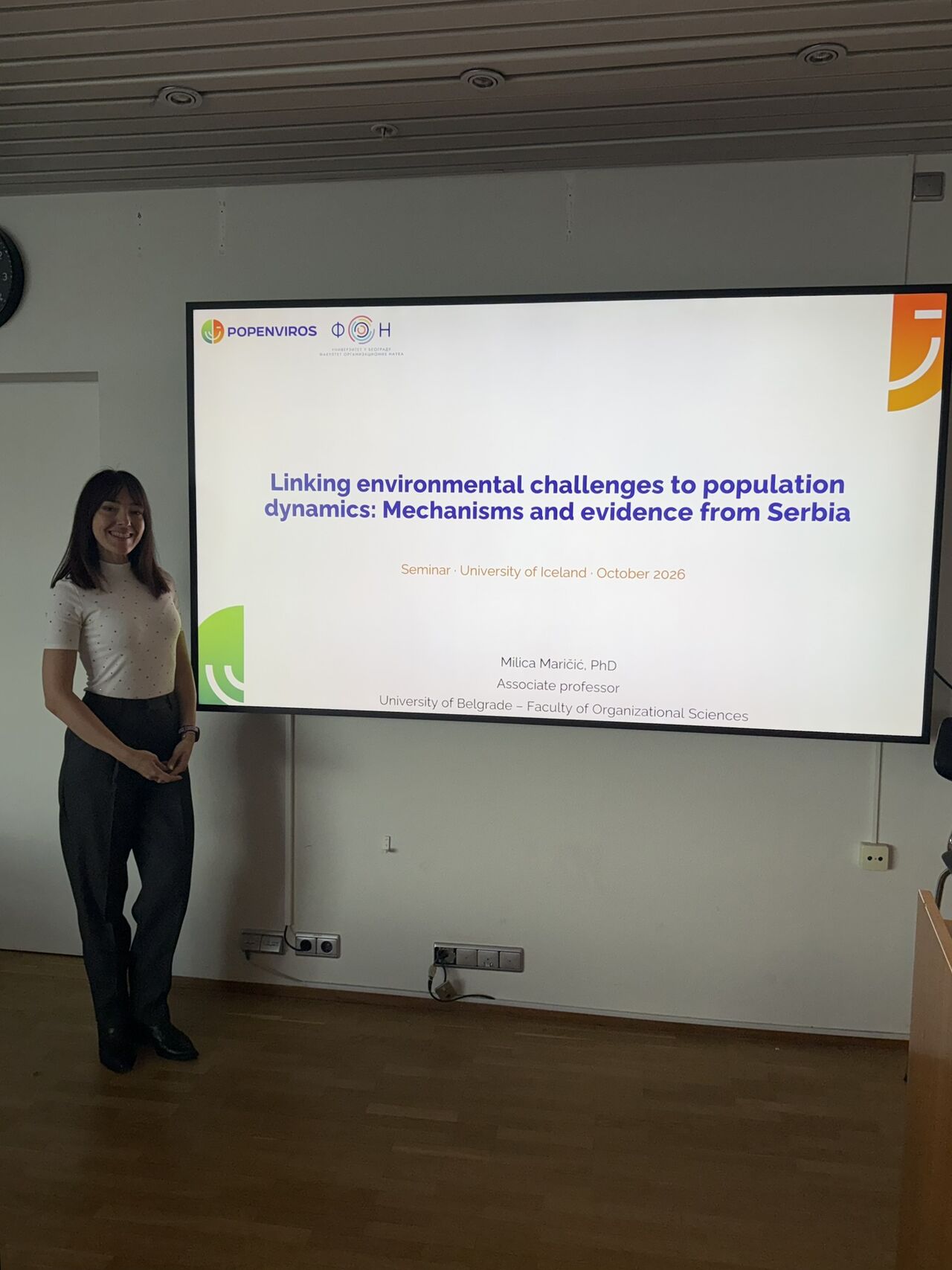
Milica Maričić recently completed a research visit to the University of Iceland (Háskóli Íslands), where she delivered a seminar titled “Linking Environmental Challenges to Population Dynamics: Mechanisms and Evidence from Serbia.” During the visit, she presented three studies conducted within the national research project POPenviros – Population Dynamics under Environmental Challenges in Serbia, examining how environmental conditions shape demographic processes.
Her seminar addressed three core research themes:
- Climate and fertility: Evidence shows that each additional day with mean temperatures above 25°C is associated with lower birth rates nine to ten months later, with notable regional variation.
- Environmental and socio-economic determinants of migration: Structural equation modelling (2000–2024) highlights the joint influence of climate, agricultural land use, tourism and labour market conditions on internal out‑migration.
- Drought vulnerability and mobility: Biclustering identified distinct district profiles of drought and agricultural vulnerability, though these did not correspond to significant differences in internal out‑migration.
During her stay, Milica also attended an open seminar by Johan Rockström, whose keynote addressed planetary boundaries, climate and nature systems, and the transformations required to return societies to safe operating limits. The combination of regional empirical evidence and global sustainability perspectives underscored the importance of interdisciplinary research linking climate change, human behaviour and demographic dynamics.
She expresses gratitude to Prof. Magnfríður Júlíusdóttir and Prof. Karl Benediktsson for their hospitality and the opportunity to discuss methodological applications relevant to population change in Iceland.
